
Policy brief · Industrial revolution · Economic history
Dis-Alignment: How Guild Monopoly Broke
Summarized by Grok 4.5 · Vibe Code Racing
A synthesis of four classic papers on craft monopoly, municipal corporations, and apprenticeship: T. H. Marshall on capitalism and English guilds; J. R. Kellett on London’s guild and Corporation control; Liana Vardi on French guild abolition; and T. K. Derry on the 1814 repeal of Elizabethan apprenticeship clauses— with a complementary lens on English land monopoly from Paul Kingsnorth’s reading of the Norman conquest’s long shadow.
Through-line: compulsory craft communities eroded. Freer entry to trades expanded. What did not happen in 1814 is the invention of the corporation—that idea and its institutions long predated the industrial age. And what did not fully open with guild repeal was access to land: another closed order, with older roots, that still shapes inequality.
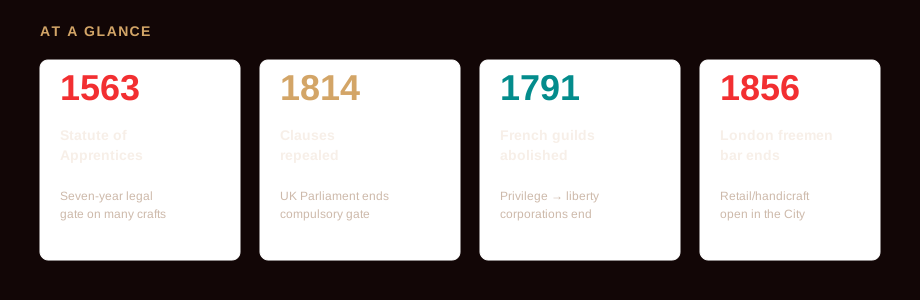
At a glance
Read separately, these papers look like local studies. Read together, they describe one arc:
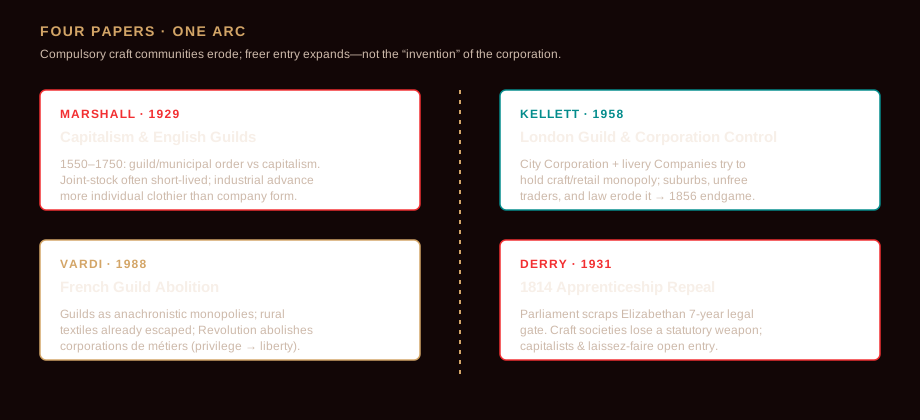
| Paper | Focus | Core claim |
|---|---|---|
| Marshall (1929) | English guilds, 1550–1750 | Old municipal/guild order vs rising capitalism; joint-stock industrial experiments often short-lived; town monopolies lose. |
| Kellett (1958) | London craft & retail control | “Corporation” = City government; “Companies” = livery guilds. Monopoly of freemen practice breaks down; 1856 formal end. |
| Vardi (1988) | French Revolution | Guilds as anachronistic monopolies; rural textiles already escaped; abolition dissolves privilege in the name of liberty. |
| Derry (1931) | UK 1814 repeal | Elizabethan seven-year apprenticeship clauses scrapped; craft societies lose a statutory weapon; capitalists and laissez-faire open entry. |
| Kingsnorth (2012) | Land & Norman conquest | Extreme land concentration in Britain is not a modern accident; it tracks a post-1066 land grab and feudal settlement that outlived guild monopoly of the shop floor. |
1. Vocabulary first: corporation did not mean “startup”
Modern rhetoric often treats “the company” as a sudden sovereign invention that replaced trust-based family firms and invented stockholders. These papers use older words differently.
- Corporation (Kellett): primarily the City of London Corporation—municipal government.
- Companies (Kellett, Derry): livery companies / guilds—Merchant Taylors, Distillers, Farriers, and the rest—bodies regulating who may practise a craft.
- Corporations de métiers (Vardi): French craft guilds as privileged estates in a larger corporate social order.
- Apprenticeship clauses (Derry): the parts of Elizabeth I’s Statute of Apprentices (1563) requiring many craftsmen to serve (classically) seven years before lawfully practising their trade.
2. Marshall: capitalism against the guild order—not guilds inventing capitalism
T. H. Marshall’s Capitalism and the Decline of the English Guilds (1929) places 1550–1750 as a period when “old and new were at grips, and the new was capitalism.” Medieval/local/guild/regulated systems faced modern/national/capitalist/competitive ones.
Crucial corrections from Marshall’s reading of the evidence (via Stella Kramer and debate with Unwin):
- Many guild amalgamations were defensive municipal reorganizations—not steps toward industrial capitalism.
- Conflicts between crafts often reflected jealousy among equals, not a clean merchant-capitalist takeover of manufacturers.
- Joint-stock industrial companies (soap, paper, linen, glass, etc.) appear—but Marshall treats many as speculative, short-lived, and secondary to the “genuine industrialist” advancing “in his own natural, individualistic way.”
- Towns fought to keep manufacture and markets inside borough walls; Parliament eventually admitted village industry could not be suppressed.
- Trade monopolies became unpopular; restrictions on middlemen eased; the ideal of regulated industry was challenged by demands for freedom.
Marshall’s late note is political as much as economic: equality among masters eroded; merchants looked down on manual craftsmen; “apprentice” covered both pauper children and rich merchants’ sons. Democracy inside guilds gave way to oligarchy—even as municipal economic authority faded into the eighteenth century.
3. Kellett: London’s monopoly dies slowly—with data
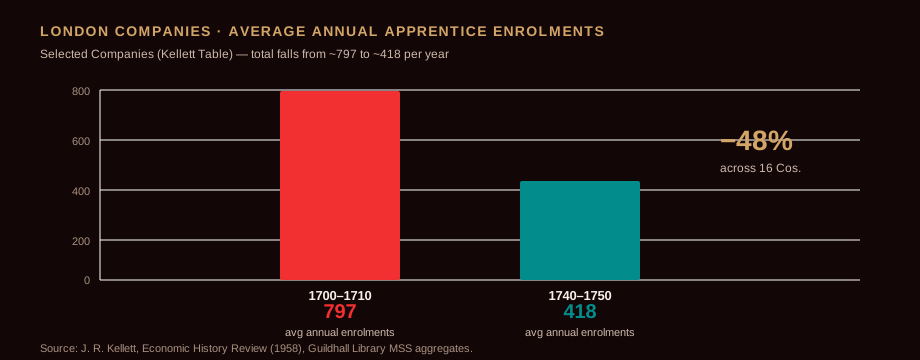
J. R. Kellett’s The Breakdown of Guild and Corporation Control over the Handicraft and Retail Trade in London (1958) is the microscopic companion to Marshall’s panorama. By the late seventeenth century, guild control over London crafts was already weakened by suburbs and unfree production. The City and Companies spent the next century and a half trying—and failing—to put the monopoly back together.
Legal hits
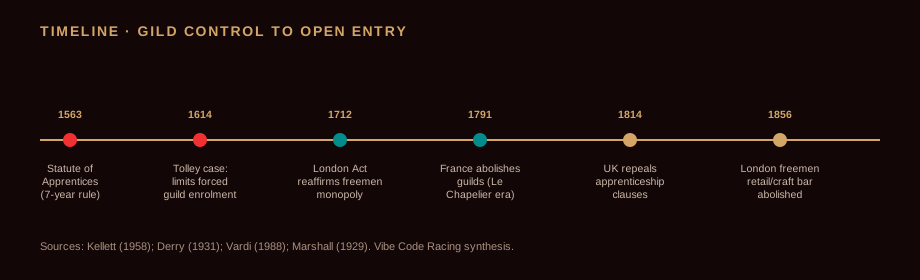
Common-law cases, including the oft-cited Tolley case (1614), limited forced enrolment and forced trade after a valid apprenticeship. A freeman who had served seven years might “well and lawfully relinquish that Trade and exercise any other Trade at his will and pleasure.” That is occupational freedom against compulsory guild membership—not “opting out of an open-source network.”
Enforcement costs
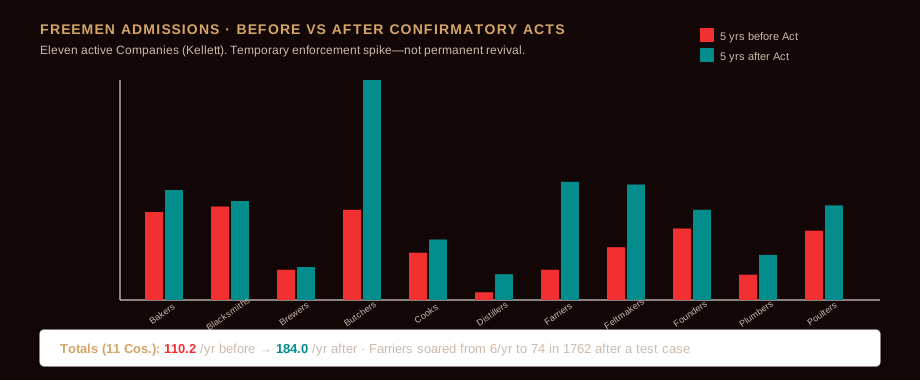
Searches, quarterage, informers, and prosecutions were expensive and unpopular. Companies hesitated to sue in their own name; freemen risked temporary disfranchisement if they testified. Even mid-eighteenth-century confirmatory Acts of Common Council only postponed the end.
Endgame
- 1814: apprenticeship regulations in 5 Eliz. c. 4 set aside nationally (Derry’s subject; footnoted by Kellett).
- 1835: Municipal Corporations Act—every person in any borough may keep shop for lawful wares.
- 1856: London formally abolishes laws barring non-freemen from retail business or handicraft.
After that, most livery Companies become administrators of freehold and trust estates plus convivial, charitable, and educational clubs— not governors of the workshop floor.
4. Vardi: France abolishes guilds that were already losing
Liana Vardi’s The Abolition of the Guilds during the French Revolution (1988) argues that French guilds’ primary role was economic—and that as such they were anachronistic and effectively moribund by the late eighteenth century.
- Critics (Turgot’s circle and others): guilds kept prices high, blocked able craftsmen with entry fees, fought endless border lawsuits, stifled innovation.
- Apologists: privilege protected quality and social order against “license.”
- Textiles—the major preindustrial manufacture—had moved rural partly to escape guild encroachment; the 1762 edict sanctioning rural production was a death knell.
- Privileged manufactures, special enclaves, and illegal workers undermined urban monopoly even before Revolution.
- Small workshop production continued without needing special monopolies—do not confuse artisanal production with the corporative system.
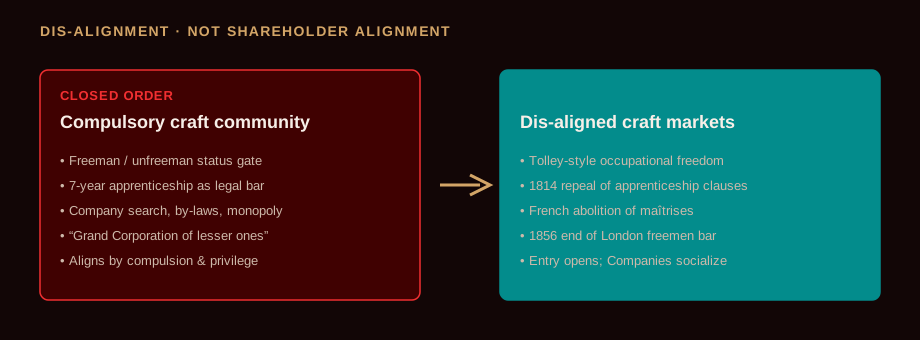
Revolutionary abolition dissolves craft corporations as privileged bodies in a chain of estates (clergy, nobility, courts, finance companies, trading companies). The political language is liberty against privilege—not shareholder alignment.
5. Derry: what apprenticeship clauses were—and what 1814 did
Apprenticeship clauses = the parts of the 1563 Statute requiring many craftsmen to complete a formal multi-year servitude (classically seven years) before lawfully practising their trade. They were a legal gate on labour, not a corporate charter statute.
By ~1800 the law was already whittled by hostile judges and gaps for post-Elizabethan trades. Craft societies and some London Companies tried to revive enforcement against “colts” (illegal workers) and factory dilution. Capitalist manufacturers—especially in woollens—obtained suspension and then repeal for their trade (1809), then a broader parliamentary strike in 1814.
Derry’s nuance matters for policy history: repeal was not a pure philosophical triumph of free trade alone. Public attention was elsewhere (peace negotiations, Corn Law debates); cabinet members sat out; the bill moved through a thin house. Still, the legal effect was clear: the Elizabethan compulsory gate fell.
Craft defenders even described Britain as “a grand Corporation, composed of an infinity of smaller ones”—an ideology of nested privilege under attack. Derry, summarizing Company resistance to enemies of the “corporation spirit”
6. The through-line: dis-alignment, not invention
A defensible synthesis—and a direct rebuttal of corporate creation myths that misuse this history:
- Corporate organization already existed. Guilds, City Corporations, privileged estates, chartered trading companies, even joint-stock experiments.
- They regulated entry, training, and markets via freemen status, apprenticeship, search, and monopoly—not via modern mass equity.
- From the 16th to 19th centuries that order erodes: suburbs, rural industry, common-law limits, unpopular monopolies, capitalist contractors, physiocratic/liberal critique, French abolition, English repeal.
- 1814 weakens compulsory craft entry; it does not invent corporate legal personality.
- What expands is freer practice of trades—dis-alignment of closed craft communities—while many Companies become social and proprietorial clubs.
- Land monopoly is a parallel closed order (Kingsnorth): crown-and-elite land concentration after 1066 did not fall when apprenticeship gates fell; Corn Laws and modern house-price politics still ride that structure.
7. Adjacent, not identical: Corn Laws after 1814
Do not collapse every post-1814 trade story into free markets. The Corn Laws (especially 1815) restricted grain imports and protected land just as craft labour gates were opening. Craft liberalization and agricultural protection moved in opposite directions until Corn Law repeal in 1846. Derry notes MPs in 1814 were preoccupied with peace and the Corn Law—one reason apprenticeship repeal sailed with little cabinet drama.
That pairing matters for the brief’s larger claim. Opening the right to practise a trade is not the same as opening the right to own the ground under the trade. One gate can fall while another holds.
8. Land monopoly that outlived the guild gate
The four scholarly papers track the decline of craft and municipal corporate monopoly. Paul Kingsnorth’s 2012 Guardian essay “High house prices? Inequality? I blame the Normans” is not a guild study—but it is a useful counterweight. It argues that modern British land scarcity and inequality still sit on a much older settlement: the post-1066 concentration of land under the crown and its military elite.
Drawing on Kevin Cahill’s land-ownership work, Kingsnorth cites a stark distributional picture: on that account, roughly 0.3% of the population (about 160,000 families) own two-thirds of the country, and less than 1% own about 70% of the land—placing Britain near the top of rich-country land inequality. (Those figures are contested in the usual way land statistics are; the brief’s point is the structure of the claim, not a cadastral audit.)
The historical mechanism he emphasizes:
- 1067 and after: William’s first move was to declare that every acre in England belonged to the monarch—replacing a mosaic of Anglo-Saxon landholders with a single ultimate owner—then parcel land to Hastings companions. Feudal tenure and a durable landowning elite follow.
- Continuity of winners: dukes, earls, and great estates still sit atop that grab; crown ownership remains the deep legal fiction of ultimate title in the common-law imagination he invokes.
- Method of rule: castles, harsh taxation (Domesday as a fiscal instrument), and later export of the same colonising template into Ireland, Scotland, and Wales—what one historian he cites called “medieval apartheid.”
- Industrial question: he asks whether the industrial revolution and empire could have taken the same shape without that intense concentration of land and power—and whether English political culture’s deference is partly an inheritance of conquest.
- Resistance tradition: Norman rule met guerrilla “silvatici”; he traces that spirit through later English revolt folklore (Peasants’ Revolt, Robin Hood)—not everyone took enclosure of power lying down.
“Could the industrial revolution, even the empire, have happened in the same way without that intense concentration of land and power?” Paul Kingsnorth, The Guardian, 17 December 2012
9. Why this matters for policy language now
When contemporary open letters and tech narratives treat “the company” as history’s great invention that replaced trust and created stockholders, these sources are a useful brake:
- Institutions first: define whether “corporation” means municipal body, craft guild, chartered trader, or limited company.
- Monopoly vs openness: guild history is often about compulsory exclusion breaking down—not private firms receiving super-personal power for the first time.
- Labour gates vs capital forms: apprenticeship clauses governed who may work; they are not interchangeable with limited liability or equity markets.
- Path dependence: free entry to crafts and free trade in grain were separate fights with separate winners.
- Land is not labour: opening the shop floor does not automatically open the soil. Land concentration and house-price politics (Kingsnorth’s contemporary frame) sit in a different institutional stream—one that can keep inequality high even after guilds lose their legal teeth.
For a contemporary companion on infrastructure, forced labour, and compute politics, see From Cotton to Compute in the Policy Briefs library. For satirical commentary, see the open-weights letter and the recycled toilet paper letter.
Sources
- T. H. Marshall, “Capitalism and the Decline of the English Guilds,” Cambridge Historical Journal 3, no. 1 (1929): 23–33. PDF: download
- J. R. Kellett, “The Breakdown of Guild and Corporation Control over the Handicraft and Retail Trade in London,” Economic History Review N.S. 10, no. 3 (1958): 381–394. PDF: download
- Liana Vardi, “The Abolition of the Guilds during the French Revolution,” French Historical Studies 15, no. 4 (1988): 704–717. PDF: download
- T. K. Derry, “The Repeal of the Apprenticeship Clauses of the Statute of Apprentices,” Economic History Review 3, no. 1 (1931): 67–87. PDF: download
- Paul Kingsnorth, “High house prices? Inequality? I blame the Normans,” The Guardian, 17 December 2012. theguardian.com/…/high-house-prices-inequality-normans (opinion; cites Kevin Cahill on land ownership).