
Long read · Policy synthesis · Vibe Code Racing
From Cotton to Compute: Forced Labour, Surveillance Racks, and the Fight Over Who Builds AI Infrastructure
Summarized by Grok 4.5
A synthesis of the UK House of Commons BEIS report (2021), C4ADS’s Hardwired Repression (2026), and Garry’s List reporting on US data-centre politics (drawing on Bitcoin Policy Institute research)
Long-form for blog publication · Sources as cited. Mentions of companies or entities do not imply illegal conduct; see disclaimers in the source documents. BPI and Garry’s List explicitly note that not every local opponent of a data centre is part of any foreign network.
At a glance
Three public sources, read together, describe the same object—the data centre—from three angles that rarely share a page:
| Lens | Source | Core claim |
|---|---|---|
| Goods & labour | UK House of Commons BEIS Committee, Uyghur forced labour in Xinjiang and UK value chains (HC 1272, Mar 2021) | Fashion, retail, media and tech firms selling into the UK cannot guarantee their value chains are free of forced labour tied to the Uyghur region. |
| Compute & surveillance | Mishel Kondi / C4ADS, Hardwired Repression (2026) | Data centres and “smart campus” systems in China’s Uyghur region—often specified with American and Taiwanese hardware—form the digital backbone of mass surveillance, including against ethnic minorities. |
| Compute & growth (US) | Garry Tan / Garry’s List, The Campaign to Kill American AI Runs Through San Francisco (2026), synthesising Bitcoin Policy Institute (BPI) Parts I–II | While China subsidises AI data-centre energy and races to build capacity, US projects face moratoria and zoning fights; BPI documents campaigns that delayed or blocked roughly $23.6 billion in AI data-centre investment across 14 states, and argues foreign-linked funding streams run parallel to authentic local environmental concern. |
The through-line is not “data centres good” or “data centres bad.” It is sharper:
Data centres are dual-use infrastructure in every sense that matters. In western China they can power atrocity-adjacent surveillance while feeding a national Eastern Data, Western Computing buildout. In the United States they are the scarce substrate of AI-era growth—power, chips, models, applications, standards—while becoming the object of political campaigns that, if BPI’s evidence holds, include foreign influence operations aimed at slowing the American stack. Cotton and clothing were the last decade’s supply-chain stress test. Racks and kilowatts are this decade’s.
1. Why read these sources together
The UK report was written when global attention focused on mass detention, cotton, and brand supply chains. C4ADS arrives after the most visible camp architecture has largely given way to a more diffuse system—and after AI, export controls, and data-centre geopolitics have become central to China policy. Garry’s List and BPI arrive from the other shore of the Pacific: the question is no longer only what Western technology enables inside China, but whether the United States will let itself build the compute layer at home.
Reading them side by side matters for four reasons:
- Continuity of harm. The UK and C4ADS documents treat forced labour, surveillance, and cultural repression as interlocking tools of state policy—not isolated scandals.
- Shifting form of entanglement. In 2021, the hard question for UK consumers was: Is my T-shirt clean? In 2026, C4ADS adds: Is mid-tier Western silicon still wiring the servers that track a population under atrocity-crime scrutiny?
- Asymmetric industrial policy. C4ADS shows a Chinese state pushing compute into energy-rich western regions. Garry’s List / BPI describe US localities voting permanent bans and multi-state campaigns that delay tens of billions in capacity—while Chinese English-language media, per that reporting, warns Americans that US data centres raise their electricity bills.
- Policy lag on both ends. Modern Slavery Act statements, securities bans, and high-end chip export controls leave predictable gaps on the China side. On the US side, treating every data-centre fight as pure NIMBY environmentalism may miss coordinated influence when it exists—and treating every activist as a foreign agent may miss authentic land, water, and power concerns. BPI and Garry’s List insist on holding both truths at once.
This article summarises the evidence, adds visual synthesis, and keeps one through-line in view: from cotton fields to compute racks to contested American permits, infrastructure is where human rights, growth, and great-power competition now meet.
2. Shared factual baseline: what both reports take as given
Neither report is a first-discovery of abuses. Each rests on a stack of prior findings by the UN system, NGOs, journalists, and governments.
Scale of repression
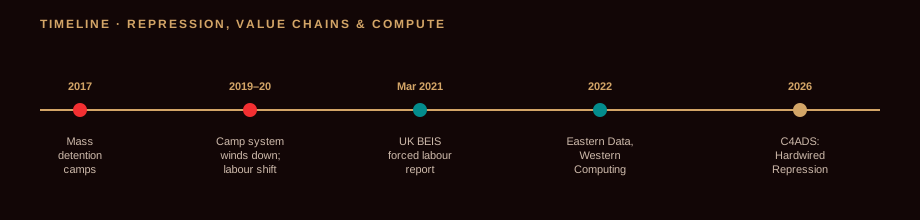
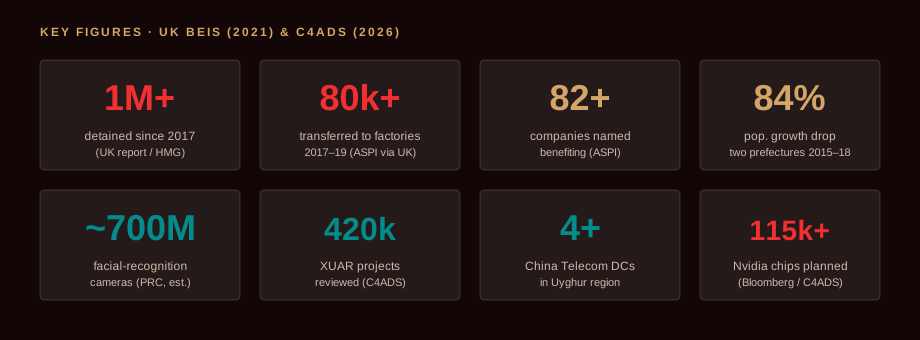
The UK Committee cites UK Government acknowledgement of compelling evidence of widespread and systematic human rights violations, including extrajudicial detention of over a million Uyghurs and other minorities since 2017. It notes World Uyghur Congress and Amnesty material on mass “re-education,” BBC and Human Rights Watch reporting on camp discipline, torture, and surveillance, and later BBC reporting on systematic rape in camps.
C4ADS places the same mass-detention wave in a longer arc: since 2017, millions were held in “vocational education and training centres” as part of a campaign the United States and others have designated a genocide. Highly militarized camps were wound down around 2019–2020—not, in C4ADS’s reading, as liberalization, but as a tactical shift into a more diffuse, economically integrated forced-labour apparatus.
Demographic and cultural coercion
The UK report highlights Uyghur Human Rights Project evidence of cultural landmark destruction and forced sterilisation, with population growth falling by over 84% in the two largest Uyghur prefectures between 2015 and 2018.
Forced labour transfers
Drawing on ASPI’s Uyghurs for Sale (2020), the Committee notes:
- At least 80,000 Uyghurs transferred out of Xinjiang to factories across China in 2017–19 under state “Xinjiang Aid” programmes.
- 27 factories in nine provinces identified as using transferred labour.
- More than 82 foreign and Chinese companies assessed as directly or indirectly benefiting—including names in automotive, fashion, retail, and IT (ASPI’s original list included firms such as Adidas, Amazon, Apple, Nike, Samsung, Uniqlo, and others; ASPI later updated correspondences from brands).
C4ADS does not re-litigate the factory map; it treats forced labour and atrocity crimes as documented context for why surveillance infrastructure in the region is not a neutral commercial buildout.
Surveillance state capacity
C4ADS estimates the PRC operates on the order of ~700 million facial-recognition cameras nationally, with the Uyghur region under heightened monitoring: checkpoints, Wi-Fi sniffers, biometric collection, and platforms such as the Integrated Joint Operations Platform (IJOP). System triggers can include indications of ethnic identity (for example, whether someone “looks Uyghur”). High-risk labels can lead to interrogation, coercive labour, or detention.
3. The UK report: when value chains meet “wilful blindness”
Mandate and method
In autumn 2020, the BEIS Committee opened a short inquiry into:
- Risks for UK-based businesses whose supply chains touch China / XUAR, and how to get transparency; and
- What the UK Government should do so that British businesses and consumers do not perpetuate Uyghur forced labour.
The Committee wrote to fifteen high-profile companies across fashion, retail, and technology (Adidas, Amazon, Boohoo, Disney, Gap, H&M, IKEA, Nike, Puma, Stella McCartney, The North Face / VF, TikTok, Victoria’s Secret, Zara / Inditex, and others). Most replied in writing; several appeared for oral evidence. The Foreign Affairs Committee ran a parallel Xinjiang camps inquiry; the two committees co-corresponded with brands such as Primark and Uniqlo.
What companies said—and what they could not say
A consistent pattern emerges from the report:
- No company claimed to source finished goods directly from XUAR factories in the sense of an admitted primary factory footprint there.
- None could guarantee that raw cotton in finished garments was free of Xinjiang origin.
- Segura Systems (a procurement-platform firm) told the Committee that any large retailer claiming absolute certainty that no XUAR material enters its garments is “disingenuous at best.”
That gap is structural. Xinjiang is central to China’s cotton economy; witnesses and campaigners repeatedly argued that Chinese cotton should be treated as presumptively high-risk unless proven otherwise—echoing US legislative approaches that reverse the burden of proof.
Fashion industry responses
Several brands (H&M, Puma, IKEA) pointed to the Better Cotton Initiative (BCI). BCI suspended licensing in Xinjiang in March 2020 and later ceased field-level activities there. Brands described paper trails, pilot blockchain mass-balance schemes, and experimental isotope / DNA fibre tests—tools still immature at scale.
Nike, VF Corporation, and others described codes of conduct and audits, while acknowledging that audits are “a moment in time.” Boohoo admitted it was earlier on the journey and then focused on tier-1 and tier-2 mapping; after the inquiry it appointed Sir Brian Leveson to oversee ethics and supply-chain reform.
Marks & Spencer was noted as the first UK firm to formally sign the Brand Commitment to Exit the Uyghur Region (Coalition to End Uyghur Forced Labour).
The Committee’s judgment was blunt: after years of public evidence, it was “appalled” that companies still could not guarantee supply chains free of forced labour, and that many asserted robust procedures while failing basic due diligence.
Media and tech: TikTok and Disney
TikTok told the Committee it does not operate in China and does not censor Uyghur-related content. The Committee pressed the ByteDance group structure (Cayman parent, China-facing subsidiaries) and China’s 2017 National Intelligence Law, which requires organisations and citizens to support national intelligence work and keep it secret. TikTok said it does not share UK user data with the Chinese government; the Committee invited independently verified governance and data-flow arrangements proving full legal separation of TikTok UK from other group companies.
Disney filmed parts of Mulan in Xinjiang and thanked regional security and publicity bodies in credits. The Committee was deeply disappointed that Disney declined oral evidence and, in its view, failed to answer whether adequate human-rights risk assessments and safeguards were in place. Correspondence continued after the report.
Government tools the Committee found too weak
The Committee’s critique of UK policy clusters around five themes:
- Modern Slavery Act 2015
Firms above £36m turnover must publish annual transparency statements. There is no requirement to guarantee supply chains free of slavery; an independent review found publication is not systematically monitored and penalties for non-publication were historically absent or weak. The Committee called the Act “out of date” and “has no teeth.”
- Company Directors Disqualification Act 1986
Arise and others argued director disqualification should extend to Modern Slavery Act failures. The Committee asked BEIS to review whether MSA breaches should ground disqualification.
- A new BEIS framework
A Director-led working group to coordinate enforcement, diplomacy, and sanctions. Feasibility work on a whitelist (proven clean due diligence) and blacklist (refusal or failure to evidence XUAR risk management), updated every six months, including government contractors.
- Magnitsky-style sanctions
As of the report, the UK had not yet sanctioned Chinese officials over Xinjiang abuses despite US Global Magnitsky and Entity List actions against firms such as Hikvision, Dahua, SenseTime, and earlier Huawei. The Committee rejected “insufficient evidence” as an excuse and asked BEIS, FCDO, and DIT to assess targeted sanctions on businesses implicated in exploitation.
- ODA / Newton Fund
BEIS channelled science-and-innovation ODA to China via the Newton Fund (UK investment figures cited in the hundreds of millions for the 2016–21 period). The Minister said no BEIS ODA went into Xinjiang projects or partners, but the Committee still demanded full transparency and a supply-chain review of China-based Newton-supported projects.
Foreign Secretary Dominic Raab’s January 2021 statement—export-control review for Xinjiang, financial penalties for missing modern slavery statements, new business guidance—was welcomed as directionally correct but judged insufficient to stop UK commerce from profiting from forced labour.
4. The C4ADS report: when the server room is the security state
If the UK report maps what leaves the region in shipping containers, Hardwired Repression maps what goes into the region in racks and PCI slots.
Method
C4ADS reviewed roughly 420,000 projects approved by XUAR authorities and the Xinjiang Production and Construction Corps (XPCC)—a paramilitary economic organisation sanctioned by the US, UK, Canada, EU, and Australia for its role in persecuting Uyghurs. Analysts filtered for data centres (数据中心) and mapped corporate and technology links, then developed two case studies.
Limitations (explicit in the report): case studies illustrate rather than statistically generalise; China’s information environment constrains evidence on land coercion and environmental harm tied to data-centre construction—even as other research documents coercive land practices in the region.
Eastern Data, Western Computing—and the borderlands
In 2022, Beijing launched Eastern Data, Western Computing (EDWC / 东数西算): eight national data-centre hubs that push energy-hungry compute westward while feeding eastern economic demand. XUAR and Tibet are not named as formal hubs, but C4ADS finds local officials invoking the national frame as buildout accelerates in western border regions.
The Uyghur region’s attractions for compute are material: space, cooler climate (lower cooling cost), and—for training-heavy AI and predictive policing—tolerance of latency that would hurt interactive apps in Shanghai or Shenzhen. The same geography is a “crucial component” of the Belt and Road Spatial Information Corridor and a node of the Digital Silk Road toward Central Asia: fibre, data flows, telecom standards, and potential cross-border data processing that raise data-sovereignty concerns for neighbours.
C4ADS also notes a documented Tibet ↔ Uyghur region feedback loop in surveillance experimentation: tactics piloted in one autonomous region reappear in the other.
Case study 1 — Yanqi Vocational Technical School “Smart Campus”
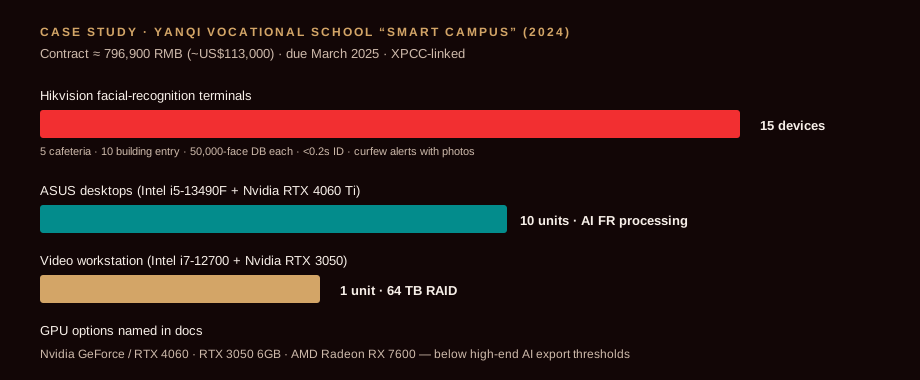
Vocational schools in the region have long been criticised as sites of indoctrination, forced assimilation, and detention-adjacent control. Yanqi’s October 2024 contract for a “Smart Campus” surveillance system—about 796,900 RMB (~US$113,000), completion targeted March 2025—shows how that control is instrumented with commodity Western and Chinese hardware.
What the system does (per C4ADS’s reading of procurement docs):
- Tracks attendance, meals, dorm movements, social patterns, and schedule compliance.
- Deploys 15 Hikvision facial-recognition devices (5 cafeteria, 10 building entry).
- Each terminal: 50,000-face database, identification in under 0.2 seconds, anti-spoofing, automatic alerts with photos for curfew or access violations.
- 10 ASUS desktops with Intel Core i5-13490F and Nvidia GeForce RTX 4060 Ti for AI facial-recognition processing.
- Video workstation: Intel i7-12700, Nvidia RTX 3050, 64 TB RAID.
- Project docs also name Nvidia RTX 4060 / 3050 and AMD Radeon RX 7600 options—chips that sit below high-performance AI export-control thresholds.
The policy implication is sharp: export controls aimed at frontier AI accelerators do not by themselves stop the surveillance pipeline. Once unrestricted chips leave the factory, end-use verification—especially against resale and repackaging—is “extraordinarily difficult.”
Case study 2 — China Telecom Xinjiang
China Telecom Xinjiang is a wholly owned subsidiary of China Telecom Corporation Limited, a major SOE with deep military-industrial and critical-infrastructure ties. The parent has faced US measures including:
- Listing on OFAC’s Chinese Military-Industrial Complex Companies list (restricting US persons from trading its securities);
- GSA SAM exclusion (no US government contracts);
- NYSE delisting and large foreign investor exits (e.g. BlackRock) around 2021.
C4ADS’s critique is that those tools do not automatically throttle the subsidiary’s regional buildout the way an SDN “50% rule” would, and that Entity List treatment would be more consequential for hardware, software, and technology exports.
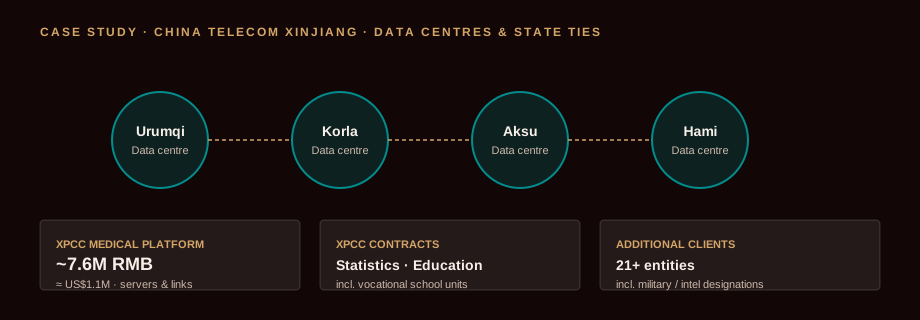
As of March 2026, the report finds China Telecom operating at least four data centres in the Uyghur region—Aksu, Urumqi, Hami, and Korla—and providing mixed commercial and government services, including programmes framed as “poverty alleviation,” which C4ADS links to the broader coercive campaign.
XPCC and security-adjacent footprint (examples cited):
| Relationship | Detail (C4ADS) |
|---|---|
| XPCC Statistics Bureau | Build/maintain dedicated facility for servers, storage, networking; multi-year maintenance |
| XPCC Education Bureau | Equipment-room services for bureau and subordinate units, including vocational schools |
| XPCC Medical Insurance Information Platform | ~7.6 million RMB (~US$1.1M) — largest cited XPCC contract with China Telecom Xinjiang |
| Wider client set | 21+ additional entities, including Chinese military / intelligence designations (“A Unit”) |
| Defence-adjacent suppliers | Transmission and security services from named defence contractors |
The parent company’s website, C4ADS notes, still presents US data-centre operations, while branches remain active in Europe and Australia—illustrating how commercial globalisation and security designations can run on separate tracks.
Why Western brands still appear in XUAR data-centre specs
Despite “Made in China 2025,” AI plans, and Five-Year Plan self-reliance goals—and despite US chip controls since 2022—C4ADS’s 2024–2025 document review finds American and Taiwanese technology still referenced across regional data-centre projects: Intel, Nvidia, AMD, Dell, HP, Microsoft, Cisco, VMware, QNAP, storage brands such as Western Digital and Seagate, often below the banned high-end AI tier. Domestic alternatives (Huawei, H3C, Inspur, Tencent Cloud, Kylin OS) rise in parallel under localisation (国产化) preferences.
C4ADS offers several non-exclusive explanations for dual requirements (Western compatibility + domestic preference): migration from legacy Western stacks; hedging on future policy; interoperability with global standards; and, for controlled items, the possibility of smuggling / third-party transshipment.
A separate Bloomberg analysis cited in the report finds Chinese firms planning to install more than 115,000 Nvidia AI chips across at least three dozen data centres in the Uyghur region and neighbouring Qinghai—chips that were subject to US export controls at the time. Whether above or below thresholds, C4ADS concludes corporate due diligence alone has not severed Western technology from repressive infrastructure.
Implications beyond Xinjiang
Data centres in the region, in this account, are dual-use in the geopolitical sense:
- Internally: continuous, AI-assisted social control.
- Externally: infrastructure power along corridors into Central Asia, with PRC law enabling state access to data held by Chinese SOEs—even when facilities sit abroad.
- Domestically networked: firms serving prisons and governments in other provinces, spreading methods beyond the autonomous region.
That is the China side of the rack: state capacity, minority control, corridor power, hybrid Western-and-domestic silicon. The United States is fighting a different battle over the same industrial object—often in the name of electricity bills and watersheds, sometimes, according to BPI, with help that does not start in the city council chamber.
5. The other shore: when America debates whether to build at all
Garry Tan’s Garry’s List essay The Campaign to Kill American AI Runs Through San Francisco (2026) is a builder’s brief, not a parliamentary report. It rests heavily on two Bitcoin Policy Institute studies on foreign influence in campaigns against American AI data centres. Its central claim is stark:
The choice the United States faces on artificial intelligence is not AI vs. no AI. It is American AI or Chinese AI.
That framing pairs uncomfortably well with C4ADS. If Beijing is treating western data centres as national strategy—energy in, compute out, standards and surveillance downstream—then every delayed American campus is not a local zoning footnote. It is relative capacity in a race both governments already describe in strategic language. The White House AI Action Plan, as cited by Garry’s List, states that whoever builds the largest AI ecosystem will set global standards and reap economic and military benefits. China, the same piece reports, has subsidised up to half the energy costs of its AI data-centre operators while running English-language state media that warns American consumers US data centres raise their power bills.
What BPI says was blocked
BPI Part II (Sam Lyman), as summarised by Garry’s List, documents 21 campaigns by the Party for Socialism and Liberation (PSL)—a Marxist-Leninist organisation whose senior leadership, BPI argues, doubles as executive staff at Singham-funded nonprofits—that delayed, blocked, or forced withdrawal of approximately $23.6 billion in AI data-centre investment across 14 states. Part I maps three foreign vectors: Chinese state media, the Neville Roy Singham nonprofit network, and foreign-billionaire charitable vehicles funnelling more than $2 billion into US advocacy infrastructure over time.
California is both the place that produces much of American AI and, in this telling, home to some of the network’s most active nodes:
| Node (per Garry’s List / BPI) | Claim summarised |
|---|---|
| 2969 Mission St, SF | Shared building: PSL Mission Liberation Center and ANSWER SF chapter; Liberation Centers framed as ground game for packing councils and killing permits (28+ centres nationally). |
| CodePink / Jodie Evans | Evans is Singham’s wife; NYT-documented Singham-linked donations; Senate Judiciary (Grassley) letter asking DOJ whether FARA registration is required; Feb 2026 Bay Area push at Sierra Club Oakland to oppose AI data centres. |
| ClimateWorks (SF) | Pass-through for Oak Foundation “greening” Belt and Road work; co-authored BRI decarbonisation roadmap with Tsinghua; channels into CA groups on anti–data-centre coalitions. |
| Jaan Tallinn / SFF orbit | Separate foreign vector: AI-safety funding (e.g. MIRI, CAIS); “Stop the AI Race” rally outside Anthropic, OpenAI, xAI—different politics, same target: slow US buildout. |
Garry’s List is careful—following BPI—to say not every local opponent is connected to this network. Monterey Park’s 86% vote for a permanent data-centre ban (June 2026, first in the country by public vote in that telling) may blend genuine local preference with a national playbook. Pittsburg, Oakley, and Gilroy appear as Bay Area fights using language that BPI argues tracks a domestic content operation. A federal grand jury, per the essay, is investigating Singham-linked nonprofits for wire fraud, bank fraud, and possible money laundering. Those are allegations under investigation, not adjudicated findings—this article reports the claim, not a verdict.
Juxtaposition: who builds the rack?
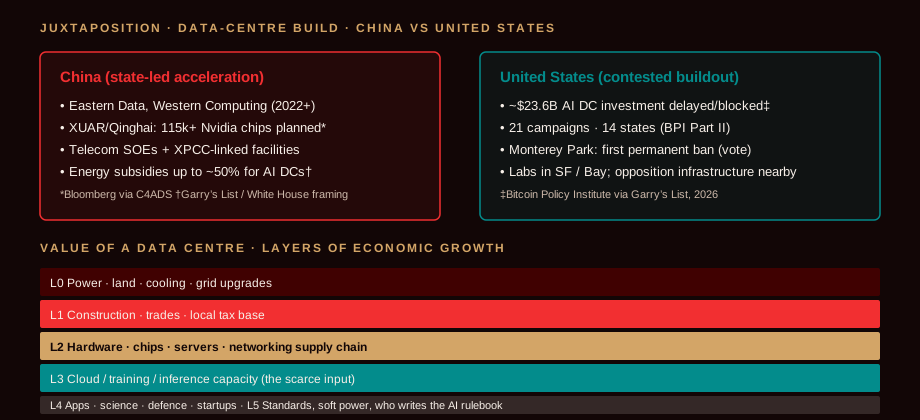
Put C4ADS and Garry’s List / BPI on one diagram and the asymmetry is almost cartoonish:
| China (C4ADS + policy frame) | United States (Garry’s List / BPI) | |
|---|---|---|
| State posture | EDWC, localisation + still-hungry for Western chips; energy and land pushed west | Contested federal ambition vs local veto; AI Action Plan vs city moratoria |
| Flagship geography | Uyghur region, Qinghai, western hubs | SF Bay labs; blocked or delayed projects from CA to 14 states |
| Money signal | Subsidies (e.g. energy cost support for AI DCs, per Garry’s List); large planned GPU installs | ~$23.6B delayed/blocked AI DC investment (BPI Part II) |
| Civil society role | Constrained; SOE/paramilitary actors dominate infrastructure | Open protest, foundations, city councils—and, BPI argues, foreign-funded nodes inside that openness |
| What the rack enables | Training, cloud, and surveillance of minorities; corridor power to Central Asia | Training, cloud, science, startups, defence—if permitted |
The moral discomfort is intentional. Opposing a data centre next to a watershed is not the same thing as abetting forced labour in Xinjiang. Refusing mid-tier GPUs that end up in a “smart campus” that photographs curfew violations is not the same thing as banning compute in Monterey Park. But the industrial object is the same class of facility: megawatts in, silicon in, models and databases out. Strategy is the art of noticing when two local stories are one global race.
6. The value of a data centre across every layer of growth
If the only question is “Will my electric bill go up?”, a data centre is a local nuisance. If the question is “What is the production function of a twenty-first-century economy?”, a data centre is a multi-layer factory. Collapsing those layers into a single slogan—pro or con—is how policy gets stupid.
Layer 0 — Power, land, water, cooling
Without grid interconnection, transformers, and cooling (air, water, or hybrid), nothing else exists. China’s western buildout, in C4ADS’s telling, is partly a thermodynamic and spatial choice: cooler climate, more land, energy resources distant from coastal megacities. US fights often begin here: ratepayer politics, drought, diesel backups. Legitimate. Incomplete.
Layer 1 — Construction and local fiscal base
Trades, temporary employment, property tax, payment-in-lieu deals. This is the layer city councils can see. It is real—and it is the least of the national value.
Layer 2 — Hardware and the semiconductor chain
Servers, GPUs, networking, storage. This is where C4ADS’s Yanqi bill of materials (Intel, Nvidia, AMD, Hikvision) and Bloomberg’s 115,000+ planned Nvidia chips in western China stop being abstract. Every rack is demand for the industries the US still leads—and that export controls try to keep from becoming atrocity infrastructure. Blocking American campuses does not stop Chinese demand; it can redirect where the next cluster of economic activity agglomerates.
Layer 3 — Training and inference capacity (the scarce input)
Models do not train on good intentions. They train on FLOPs and memory bandwidth. Garry’s List’s line—American AI or Chinese AI—is a Layer-3 claim. Relative capacity compounds: better models attract better talent, better products, better defence applications.
Layer 4 — Applications, science, firms
Search, biotech, robotics, logistics, open-source ecosystems, university labs, startups that never raise a Series A without cheap inference. This is GDP, jobs with higher multipliers than construction, and the civilian upside of the same stack that, in Xinjiang, can be pointed at a face database.
Layer 5 — Standards and soft power
Whoever runs the largest ecosystem, the White House plan argues, writes defaults: safety norms, content regimes, surveillance norms, API power. C4ADS’s Digital Silk Road and Belt and Road Spatial Information Corridor language is Layer 5 with Chinese characteristics. A United States that under-builds Layer 0–3 while China overbuilds them is not “choosing ethics over tech.” It is ceding the rulebook.
Why human-rights readers should care about growth layers
There is a trap on the left and a trap on the right.
- Trap A: Treat every US data centre as green virtue signalling’s enemy, and discover later that the authoritarian competitor did not pause.
- Trap B: Treat every export of a gaming GPU as morally free enterprise, and discover later it is the brain of a vocational-school panopticon.
The adult position—compatible with both C4ADS and a careful reading of BPI—is discriminating dual-use policy: throttle technology that predictably becomes the nervous system of atrocity regimes; do not throttle the home buildout of the same class of infrastructure when it is the substrate of open societies’ prosperity and deterrence. That requires end-use verification (C4ADS) and clear-eyed scrutiny of who funds moratoria (BPI)—without erasing real environmental externalities or real genocide.
7. One region’s enforcement gaps—and one republic’s permit gaps
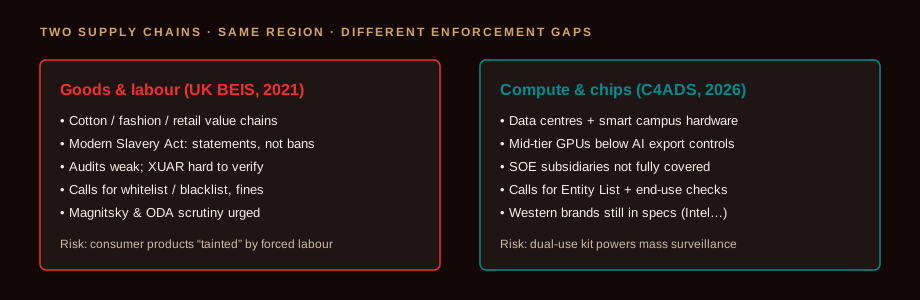
| Dimension | UK BEIS (2021) | C4ADS (2026) | Garry’s List / BPI (2026) |
|---|---|---|---|
| Primary vector | Apparel, retail, media brands | Data centres, smart campuses, telecom SOEs | US AI data-centre permits, moratoria, advocacy networks |
| Key evidence type | Brand letters, oral evidence, ASPI maps | ~420k project records, procurement specs | Campaign tallies, funding graphs, Bay Area organisational map |
| Western role | Buyers of goods / cotton inputs | Vendors of processors, GPUs, servers | Host society of open protest—and of alleged foreign influence |
| Main tools discussed | Modern Slavery Act, Magnitsky, ODA | Entity List, end-use verification | FARA scrutiny, grand jury process, industrial strategy clarity |
| Core failure mode | Transparency without guarantee | High-end controls miss mid-tier surveillance silicon | Treating all anti-DC politics as organic—or all of it as foreign |
The through-line is not that “all trade with China is illicit,” nor that “all data-centre protest is a plot.” It is that atrocity-crime geography creates a presumption of risk for exports and supply chains, and great-power AI competition creates a presumption of strategic cost for self-inflicted capacity shortages—and ordinary commercial or municipal processes were not designed to carry either load alone.
8. Recommendations side by side
From the UK Committee (selected)
- Review director disqualification for Modern Slavery Act breaches.
- Create a Director-led BEIS working group on forced labour and XUAR-linked supply chains.
- Assess whitelist / blacklist publication for company due diligence, including government contractors, every six months.
- Strengthen Modern Slavery Act: public-body reporting, accessible digital repository of statements, civil penalties for non-compliance, tougher fines.
- With FCDO and DIT, assess targeted sanctions on businesses implicated in Uyghur exploitation.
- Full ODA transparency for China programmes and Newton Fund partner/supply-chain review.
From C4ADS (selected)
- Close ownership opacity in sanctions. Add China Telecom and provincial subsidiaries (including Xinjiang) to the Commerce Entity List so US exports of hardware, software, and technology face licence requirements—not only securities trading bans.
- Mandate end-use monitoring. Make post-shipment verification mandatory for dual-use tech destined for operators in regions with documented atrocity crimes; clarify exporter liability when hardware reaches military or intelligence-affiliated end users.
Implications from the Garry’s List / BPI frame (editorial synthesis, not BPI’s formal list)
- Do not romanticise under-building. Capacity not built in Gilroy or Pittsburg is relative advantage gifted to competitors who do subsidise energy and do treat compute as national power.
- Separate externalities from strategy capture. Water, rates, and land use deserve hard engineering and fair compensation—not a blank cheque for permanent bans that ignore Layer 3–5 growth.
- Follow the money without erasing the locals. BPI’s own caveat—not every opponent is networked—should be operationalised: investigate foreign principals and fraud where evidence warrants; do not smear watershed activists as a class.
- Align export control with home industrial policy. Choking mid-tier silicon into atrocity end-uses (C4ADS) while choking domestic campuses (BPI’s $23.6B) is a self-own: deny the adversary the rack; build your own.
These agendas are complementary. The UK report tries to clean demand (what British companies buy and sell). C4ADS tries to constrain supply of the machines of control. Garry’s List / BPI try to defend supply of the machines of growth at home. A shirt without forced labour is incomplete ethics if the same state’s AI stack still treats ethnicity as a policing feature. A pure anti-data-centre politics is incomplete strategy if the competitor is wiring the desert while you pack the council chamber.
9. What a serious reader should take away
- The human-rights baseline is not “contested rumour.” A UK parliamentary committee and C4ADS treat mass detention, forced labour, demographic coercion, and algorithmic policing as established enough for legislative and export-control consequences.
- Corporate assurances without end-to-end proof are the norm—for commodities that blend (cotton) and chips that resell (GPUs below control thresholds).
- Sanctions that stop at securities listings or parent brands can leave subsidiaries and mid-tier hardware free to build the next layer of a surveillance state.
- Geography is strategy on both sides of the ocean. Energy and land make western China a compute frontier; Bay Area politics sit a few miles from the labs that need that compute.
- A data centre’s value is multi-layer. Power → construction → hardware chain → training/inference → applications → standards. Arguing only about Layer 0 electricity bills while forfeiting Layer 5 rule-writing is strategic illiteracy.
- China is building; America is litigating permits. C4ADS documents acceleration and hybrid Western silicon in sensitive regions. BPI tallies tens of billions in delayed US AI data-centre investment and maps influence networks that—if proven—exploit open societies’ openness.
- The adult dual-use stance: verify end use where atrocity risk is documented; build at home where open societies need capacity; scrutinise foreign-funded obstruction without criminalising every local “no.”
10. Sources and further reading
Primary sources for this synthesis
- House of Commons Business, Energy and Industrial Strategy Committee, Uyghur forced labour in Xinjiang and UK value chains, Fifth Report of Session 2019–21, HC 1272, ordered 9 March 2021, published 17 March 2021. Local copy:
docs/UK.pdf.
- Mishel Kondi, Hardwired Repression, C4ADS, 2026. Local copy:
docs/HardwiredRepression-C4ADS.pdf. Online: c4ads.org/reports/hardwired-repression (as cited in the report).
- Garry Tan, The Campaign to Kill American AI Runs Through San Francisco, Garry’s List, 2026.
https://garryslist.org/posts/the-campaign-to-kill-american-ai-runs-through-san-francisco
- Bitcoin Policy Institute, Foreign Influence in the Campaign Against American AI (Part I) and Part II: Singham Ground Game (Sam Lyman), as linked from Garry’s List / btcpolicy.org.
Frequently cited upstream sources
- Australian Strategic Policy Institute, Uyghurs for Sale (2020).
- Human Rights Watch, China’s Algorithms of Repression (2019).
- ASPI Xinjiang Data Project explainers on mass surveillance.
- BBC, ICIJ “China Cables,” BuzzFeed “Factories in the Camps,” and related journalism.
- Bloomberg reporting on planned Nvidia deployments in western China data centres (2025, as cited by C4ADS).
- New York Times investigation of Neville Roy Singham’s network (2023, as cited via secondary sources).
- White House AI Action Plan (as cited by Garry’s List).
- US Entity List and Global Magnitsky actions related to Xinjiang-linked entities.
Disclaimer
This article is a journalistic and analytical summary for discussion and blog publication. It does not constitute legal advice. Mention of any individual, company, organisation, or other entity does not imply violation of any law or international agreement (language aligned with C4ADS’s legal disclaimer). Claims about ongoing investigations, FARA inquiries, and foreign influence are reported from named secondary sources (Garry’s List / BPI / cited journalism) and should be checked against primary filings as they evolve. BPI and Garry’s List state that not every local data-centre opponent is part of a foreign network. Readers should consult original PDFs and reports for full footnotes, methodology caveats, and primary citations.
Appendix A — Numbers cheat sheet
| Metric | Value | Source path |
|---|---|---|
| Detained since 2017 | 1,000,000+ | UK report / HMG statements |
| Factory transfers 2017–19 | ≥80,000 | ASPI via UK report |
| Factories / provinces (ASPI) | 27 / 9 | UK report |
| Companies benefiting (ASPI) | 82+ | UK report |
| Pop. growth drop (2 prefectures, 2015–18) | >84% | UHRP via UK report |
| Facial-recognition cameras (PRC, est.) | ~700 million | C4ADS |
| XUAR/XPCC projects reviewed | ~420,000 | C4ADS |
| Yanqi Smart Campus contract | ~¥796,900 (~$113k) | C4ADS |
| Hikvision FR terminals at Yanqi | 15 | C4ADS |
| Faces per terminal | 50,000 | C4ADS |
| ID latency | <0.2 s | C4ADS |
| China Telecom DCs in region | ≥4 | C4ADS (Mar 2026) |
| XPCC medical platform contract | ~¥7.6M (~$1.1M) | C4ADS |
| Additional China Telecom clients | 21+ | C4ADS |
| Planned Nvidia chips (west China DCs) | >115,000 | Bloomberg via C4ADS |
| MSA UK turnover threshold | £36 million | UK report |
| Companies written to by BEIS | 15 | UK report |
| AI DC investment delayed/blocked (US) | ~$23.6 billion | BPI Part II via Garry’s List |
| Campaigns / states (BPI Part II) | 21 / 14 | Garry’s List |
| Monterey Park ban yes vote | 86% | Garry’s List |
| Singham-linked nonprofit funding (claimed) | >$285 million channelled | Garry’s List |
| CodePink donations from Singham-linked sources (NYT via GL) | >$1.4 million since 2017 | Garry’s List |
Appendix B — Suggested blog packaging
- Headline options:
- From Cotton to Compute
- The Rack on Both Shores
- When Export Controls Miss the Surveillance GPU—and Permits Miss the Growth Stack
- Pull quotes:
- Segura Systems to BEIS on cotton certainty.
- Garry’s List: “American AI or Chinese AI.”
- Visuals:
docs/images/timeline, key stats, Yanqi hardware, China Telecom map, policy gap, us-china-datacenter.
Prepared for Vibe Code Racing editorial use from local PDFs in docs/ and the public Garry’s List essay. Update figures if newer editions of the underlying reports are published.
Dual format: Markdown twin at from-cotton-to-compute.md. Source PDFs: UK.pdf · HardwiredRepression-C4ADS.pdf. Garry’s List: essay.