
Long read · Policy synthesis · Vibe Code Racing
The Commoditization Fallacy: Why the CCP Is Pushing the Efficiency Narrative
Summarized by Grok 4.5
If Chinese models were already efficient enough to make U.S. capacity optional, Beijing would not need a $295 billion sovereign AI grid—while monopolizing materials, running espionage and cyber campaigns, and watching Midwest politics pause American racks.
A long-form argument from U.S. Treasury and Justice Department actions, FBI wanted notices, New York Times reporting and opinion, Tom’s Hardware on China’s AI grid, Konstantin Pilz’s DeepSeek transcript summary, JD Power / ACEA EV data, Semafor on Midwest anti–data-center politics, and Garry’s List on San Francisco political money.
Long-form for blog publication · Sources as cited. Charges, wanted notices, and indictments are allegations unless a conviction is stated; mentions of companies, nonprofits, candidates, or individuals do not by themselves establish illegal conduct. Authentic local concern about electricity bills and land use is real; it can run parallel to strategic effects that favor a peer competitor. Direct funding links from the Chinese Communist Party to U.S. political organizations are not established by the Semafor reporting cited here—what that reporting establishes is political opportunity structure.
At a glance
| Question | Short answer |
|---|---|
| What is the fallacy? | That frontier AI “will commoditize” via efficiency and open weights—so U.S. data-center buildout is wasteful FOMO. |
| Who benefits if Americans believe it? | A compute-constrained rival that is simultaneously monopolizing materials, stealing industrial time, and budgeting ~$295 billion for a sovereign AI grid. |
| What do Chinese builders say in private? | DeepSeek’s CEO: ~20,000 H-equivalent cards, prefer NVIDIA (including “non-compliant” cards), Huawei roughly 4:1 lag, still ~1/20th U.S. compute. |
| What does the rest of the stack show? | Rare-earth chokepoints, EV export scale, MSS aviation espionage, Treasury cyber, fentanyl-precursor dockets in southern Ohio—control physical and human bottlenecks, export soft narratives about software. |
| What is happening inside the U.S.? | Progressive / DSA-aligned candidates are converting data-center backlash into Midwest primary power (Semafor, July 2026)—while Beijing builds. |
The through-line this piece proves:
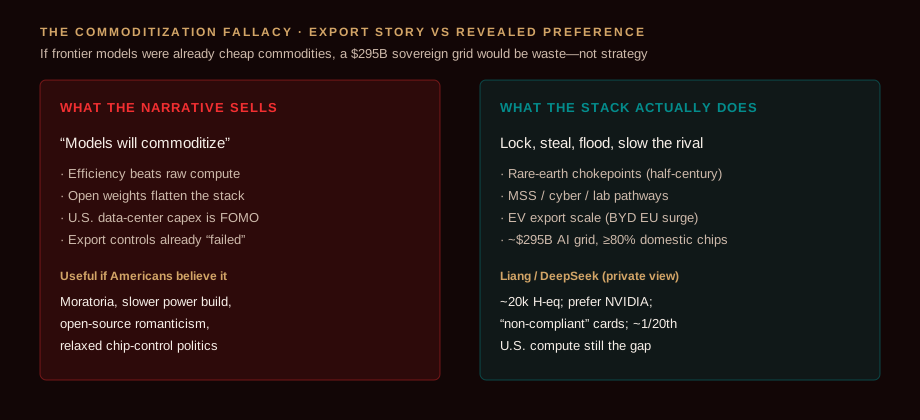
The “efficiency / commoditization” story is not a neutral technical forecast. Read against rare-earth monopoly habits, corporate espionage, cyber theft, chemical gray markets, and a planned $295 billion domestic AI grid, it functions as strategic narrative: persuade the United States that compute is no longer scarce—while China behaves as if compute, materials, and industrial capacity are the only scarce goods that matter.
If Chinese frontier models were already more efficient in the way the public story implies, Beijing would not need a national AI data-center program the size of a mid-sized country’s GDP. Revealed preference beats slogans.
1. Why “commoditization” is the load-bearing claim
Every few months the American conversation rediscovers the same comfort: models are getting cheaper; open weights close the gap; maybe we overbuilt. The comfort has a policy corollary: slow the racks. Pause permits. Mock hyperscale capex. Treat export controls as theater that “already failed.”
That corollary is the prize.
A peer competitor that is short of advanced GPUs (by its own executives’ account) and long on state capital has an obvious interest in any American consensus that says:
- You do not need more power plants and data centers.
- You should open-weight and open-source the methods layer.
- You should treat materials chokepoints as yesterday’s problem and “AI software” as tomorrow’s equalizer.
The fallacy is not that efficiency research is fake. Algorithmic improvement is real. The fallacy is treating efficiency as a substitute for capacity rather than a multiplier on capacity—and treating Chinese open-weight releases as proof that the United States can stand down industrially.
Test: If efficiency had already made frontier compute optional, the rational Chinese response would be to underbuild domestic data centers and free-ride on Western open science. The actual response, per Tom’s Hardware citing Bloomberg sources, is a draft plan to spend roughly 2 trillion yuan (~$295 billion) over five years on a nationwide AI data-center web, with at least 80% domestic chips, state carriers operating most facilities, and a single grid targeted around 2028.
That is not the balance sheet of a civilization that believes models are about to become free commodities.
2. The stack around the fallacy: other fields as evidence
The AI narrative does not float free. It sits on top of a multi-decade habit: monopolize or dominate the hard layer; talk soft about the soft layer.
2.1 Rare earths: “open” for thee, chokepoints for me
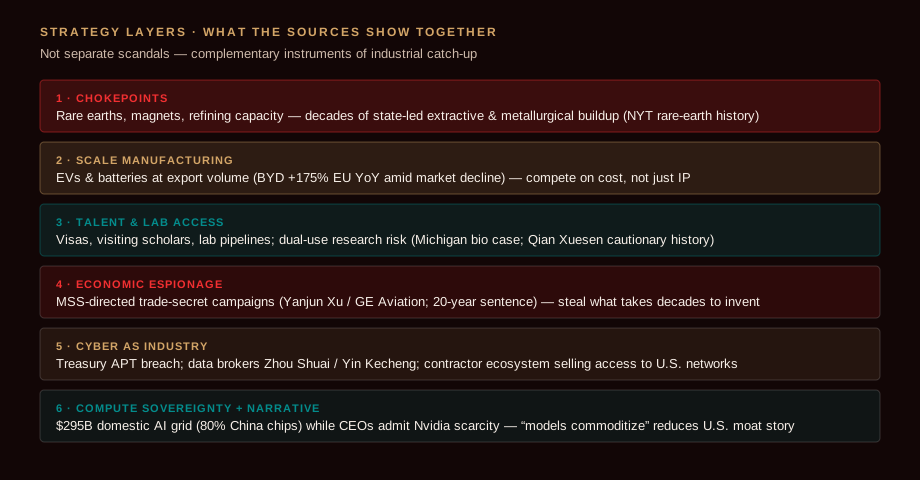
The New York Times rare-earth origin story (July 2025) is the long game in pure form. When China temporarily suspended most rare-earth exports, Western capitals scrambled—but for nearly half a century the metals had already been a top-of-government Chinese priority. After Deng Xiaoping’s rise, technocrat Fang Yi pushed extraction and separation, including from Bayan Obo, turning messy metallurgy into strategic leverage for magnets, motors, defense systems, and electronics.
Hypocrisy test: A system that spends decades building export-control power over refined materials while lecturing the world about open scientific exchange is not confused. It is asymmetric. Materials are nationalized in effect; model weights are encouraged to be shared—especially when sharing transfers methods without transferring the energy and fab stack.
2.2 Manufacturing scale: flood the market, own the learning curve
JD Power / ACEA data for January 2026 show BYD deliveries in the EU surging 175.3% year on year to 13,982 units and about 1.7% market share—while overall EU new-car sales softened. That is not espionage. It is capacity as strategy: overbuild, vertical-integrate batteries, export into political systems that still debate industrial policy as a moral failing.
Corporate espionage, when it appears, is how you skip years inside that machine—not a replacement for it.
2.3 Economic espionage: steal the years
Yanjun Xu, a Ministry of State Security officer, was the first Chinese intelligence officer extradited to the United States for trial. A Cincinnati jury convicted him of economic espionage and trade-secret conspiracies aimed at aviation leaders, including GE Aviation’s exclusive composite engine fan module. He was sentenced to twenty years (November 2022; later affirmed on appeal). Front companies, university invitations, hotel-room computer access, parallel French aerospace targeting—this is professional service work, not a confused grad student.
Read with the AI narrative: When the same system says “software will commoditize, relax,” while its intelligence service spends years on hardware-adjacent industrial secrets, believe the intelligence service about what is scarce.
2.4 Cyber: map the Treasury and the brokers
In December 2024, U.S. officials disclosed a China state-sponsored APT breach of Treasury systems via a BeyondTrust remote-support key—a “major cybersecurity incident” aimed at unclassified workstations and documents. In March 2025, OFAC designated Zhou Shuai and Shanghai Heiying, a data-broker ecosystem collaborating with previously sanctioned Yin Kecheng (tied to the Treasury compromise). Victims spanned tech, defense industrial base, communications, health, and local government. State offered rewards up to $2 million each for Yin or Zhou.
Cyber is how you buy foresight—sanctions timing, corporate data, personnel maps—while the efficiency narrative buys time in American legislatures.
2.5 Talent pathways: dual caution
DOJ’s November 2025 complaint against University of Michigan PRC research scholars for alleged biological-materials smuggling conspiracy sits beside the NYT opinion on Qian Xuesen: deporting a cleared rocket scientist in the 1950s gifted China a missile program. Both lessons stand. Openness without enforcement is a gift; dragnets without discrimination are also a gift. The party-state needs enough pathways, not every student as an agent.
3. Ohio: fentanyl dockets, aerospace IP, and Wright-Patterson’s neighborhood
Southern Ohio is not a random pin on a map. It is an aerospace and logistics corridor. Wright-Patterson Air Force Base—one of the Air Force’s most important research, acquisition, and logistics hubs—sits in the Dayton region. Cincinnati hosts major aviation industry. The Southern District of Ohio has become a recurring venue for cases that matter to this synthesis.
3.1 What the documents say
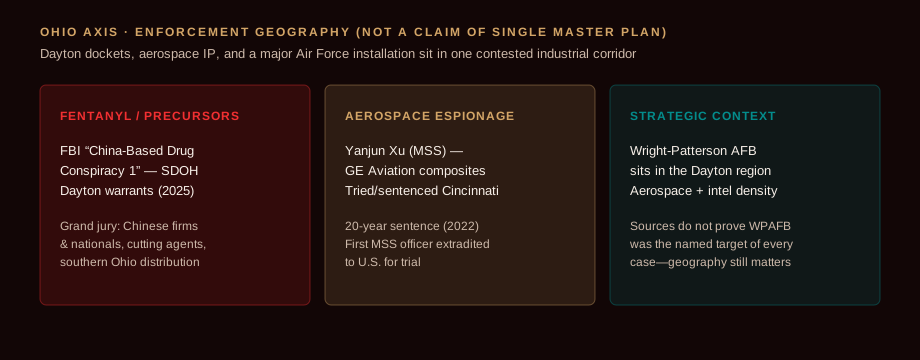
- FBI “China-Based Drug Conspiracy 1” names Chinese nationals affiliated with Guangzhou Tengyue Chemical, wanted on warrants from the Southern District of Ohio, Dayton, for alleged conspiracy to distribute controlled substances and launder money—online-pharmacy front companies shipping controlled substances and cutting agents into southern Ohio and beyond (roughly 2022–2025).
- A March 2026 Dayton grand jury charged additional Chinese nationals and pharmaceutical companies in precursor and cutting-agent conspiracies (including medetomidine in secondary reporting), money laundering, and, after cartel FTO designations, material-support theories.
- The Xu aviation-espionage trial and sentence were also Southern District of Ohio—Cincinnati.
3.2 What careful analysis may and may not claim
May claim: Enforcement geography clusters where U.S. demand, cartel logistics, and high-value industry concentrate. Dayton is both a fentanyl-crisis city in the national story and the civic neighbor of a strategic Air Force installation. Aerospace espionage cases in the same district show that Ohio’s industrial base is a prize.
Must not overclaim from this corpus alone: The FBI and DOJ releases do not, in the texts reviewed for this article, state that defendants selected Wright-Patterson AFB as a named target. Treating every southern Ohio case as a base-specific attack would invent precision the dockets do not provide.
Surmise (labeled): For a strategic competitor, harming social stability around a major military-research region, while separately targeting U.S. aviation IP in the same legal district, is consistent with multi-domain pressure—even when no single indictment says “WPAFB” in the caption. Geography is not destiny; it is not coincidence either.
3.3 Why fentanyl belongs in an AI article
Because the efficiency narrative is a soft weapon and the precursor trade is a hard one. Both can degrade American capacity: one by killing and destabilizing communities, the other by persuading elites that industrial buildout is unnecessary. A serious industrial strategy analysis does not silo “drug crime” from “tech competition” when the same rival system’s chemical industry, cyber brokers, and AI planners keep appearing in the same decade’s U.S. threat picture.
4. The American pause: Semafor, DSA-aligned politics, and the data-center backlash
On July 31, 2026, Semafor’s David Weigel reported that progressives’ Midwest insurgency is powered by the growing data-center backlash. Key facts from that piece:
- Wisconsin democratic socialist legislator Francesca Hong—described as a socialist legislator from Madison—built a large primary lead after a “Control-Alt-Delete” AI plan that starts with pausing new data-center construction.
- She tells voters she is “the only campaign that is supporting a moratorium on data centers,” citing roughly $2 billion in state tax-exemption costs.
- Marquette polling in the same cycle: 88% of Democrats said downsides of data centers outweigh benefits.
- Michigan progressives (including candidates in Senate and House lanes) moved early on limiting data centers; ads and organizing followed local fights (e.g. Lyon Township).
- National left infrastructure has been pushing the frame: Sanders strategist Faiz Shakir urging Democrats to run against data-center construction; Sanders and Rep. Alexandria Ocasio-Cortez proposing a national moratorium; Weigel’s own gloss that “Luddism has more grassroots support than abundance.”
- Portland DSA organizing against data centers appears in DSA’s own Democratic Left ecosystem (June 2026)—showing the issue is live inside democratic-socialist institutions, not only one Wisconsin race.
4.1 What this does not prove
Semafor’s reporting is about American electoral incentives: electricity bills, rural anger, first-mover progressive branding. It does not document Chinese Communist Party funding of DSA chapters or Midwest campaigns. Claiming a proven money trail from Beijing to DSA from that article alone would be fabrication.
4.2 What it does prove—and why it still fits the fallacy
It proves that a major faction of the U.S. left has productized anti–data-center politics into primary-winning energy at the exact historical moment China is drafting a $295 billion domestic AI grid and Chinese AI executives are admitting GPU hunger.
Strategic effect does not require a receipt:
| U.S. progressive product | Chinese industrial product |
|---|---|
| Moratoria and “pause until regulation” | Sovereign AI data-center grid |
| Tax-break repeal as identity | Special bonds + state carriers |
| “AI is the new AIPAC”-style mobilization | Domestic chip mandates (≥80%) |
| Authentic bill anxiety | Export controls on their side (foreign accelerators out of state projects) |
Prior Vibe Code Racing synthesis of Garry’s List / Bitcoin Policy Institute material already argued that authentic environmental concern can run parallel to foreign-aligned influence streams that delay U.S. capacity. Semafor shows the mass electoral face of delay. BPI-style investigations address the funding and messaging face. Both matter; conflating them without evidence is as sloppy as ignoring both.
Garry’s List’s San Francisco YCD investigation remains relevant as a different American failure mode: closed loops of public money and local power that make industrial execution hard even without foreign sponsorship. Peer competition raises the cost of ordinary corruption and ordinary Luddism alike.
4.3 Why the progressive product and the Chinese product rhyme
Weigel notes that the left is working muscles built against fossil-fuel infrastructure, and that opposing data centers may mean “stopping the erasure of millions of jobs” if AI displacement fears are right—while still winning doors on electricity bills. That coalitional tension is American. The geopolitical tension is simpler: every month of U.S. moratorium politics is a month in which Chinese carriers, bond programs, and domestic chip mandates keep stacking racks under state priority.
Sanders and Ocasio-Cortez’s proposed national moratorium, Hong’s Wisconsin pause, and Portland DSA’s local organizing are not “Chinese plots” in the Semafor text. They are American choices with Chinese beneficiaries if capacity is zero-sum in the medium run. A serious republic can tax data centers fairly, demand union labor, and still refuse to confuse bill reform with unilateral industrial disarmament.
5. Open-source for thee, monopoly for me
Here is the hypocrisy, stated cleanly:
- Materials: Multi-decade rare-earth and refining dominance; export levers when convenient.
- Factories: EV and battery scale that prices foreign competitors down the learning curve.
- Secrets: MSS and cyber campaigns against aviation IP, Treasury systems, corporate networks.
- Chemicals: China-based firms and nationals repeatedly charged or wanted in U.S. courts for precursor and cutting-agent supply into American demand markets—including southern Ohio dockets.
- Compute at home: Hundreds of billions for domestic racks; foreign chips progressively frozen out of state-funded builds.
- Compute narrative abroad: Frontier models will commoditize; efficiency wins; open weights are the future; American hyperscale is a bubble.
Items 1–5 are closed, sovereign, coercive, or extractive. Item 6 is open, cosmopolitan, and soothing.
A system that monopolizes neodymium magnets while moralizing about open model weights is not advancing a universal theory of openness. It is advancing selective openness: open what transfers U.S. advantage cheaply; close what builds Chinese advantage expensively.
DeepSeek’s public technical reputation for efficiency is real enough to launch a thousand American think-pieces. Liang Wenfeng’s leaked-call remarks, as summarized by Konstantin Pilz (July 2026), are the solvent:
- Gap with the U.S. is “really… resources.”
- ~20,000 H-equivalent cards, much newly arrived.
- Buy NVIDIA in large batches; “the more the better”; willing to pay premiums; “we can buy some non-compliant cards.”
- Huawei useful but roughly four cards ≈ one NVIDIA, multi-year lag; not enough alone for next-gen training at scale.
- “Two years behind… on one-twentieth of the compute.”
- Even large yuan budgets cannot conjure cards and power that do not exist.
If their models were truly “more efficient” in the sense that capacity no longer mattered, they would not be panic-buying NVIDIA or drafting a $295 billion grid. Efficiency is how you stretch scarce cards—not how you abolish the need for cards.
6. The $295 billion question
Restate the user’s question as a formal test:
If Chinese frontier models were already more efficient in a way that made U.S.-style capacity irrelevant, why does Beijing need a ~$295 billion national AI data-center program running on ≥80% domestic chips?
Possible answers that fail:
| Comfort answer | Why it fails |
|---|---|
| “It’s just industrial policy theater.” | Too large, too chip-specific, too carrier-integrated for pure theater; aligns with export-control pain. |
| “They’re copying Silicon Valley FOMO.” | Contradicts simultaneous domestic-chip mandates that exclude the FOMO hardware (NVIDIA) from state builds. |
| “Open-source means they don’t need scale.” | Builders still describe order-of-magnitude compute gaps and non-compliant NVIDIA demand. |
| “Export controls already failed.” | Same builders say cards are hard to get and expensive; state answers with sovereign substitution. |
Answers that fit the stack:
- They believe compute is still scarce—especially trusted, domestic, sanction-proof compute.
- They want training and inference sovereignty for commercial and military stacks.
- They want the U.S. to underbuild while they overbuild relative to their chip constraint.
- Efficiency narratives are for export; capacity programs are for home.
Tom’s Hardware’s caveats strengthen, rather than weaken, the point: SMIC utilization is tight; HBM constrains Ascend-class volume; domestic supply may cover only ~three-quarters of Chinese AI chip demand by 2030 even as the market grows. A state that still commits hundreds of billions under those constraints is not bluffing about the value of racks.
7. Synthesis table
| Domain | Chinese practice | Exportable story to the West | Result if West believes the story |
|---|---|---|---|
| Rare earths | Long-horizon monopoly / leverage | “Global markets,” interdependence | Underinvest in refining & mines |
| EVs / batteries | Scale + price + vertical integration | “Competitive innovation” only | Deindustrialization of auto |
| Aviation IP | MSS trade-secret campaigns | “Normal tech competition” | Lost years of composites R&D |
| Cyber | APT + broker ecosystem | “Everyone spies” relativism | Soft underbelly (SaaS keys) |
| Fentanyl precursors | Industrial chemistry + weak dual-use control | “Demand-side American problem only” | Community collapse; enforcement lag |
| AI models | Open-weight prestige + efficiency brand | “Commoditization / controls failed” | Moratoria; delayed U.S. power & DCs |
| AI infrastructure | ~$295B grid, 80% domestic chips | (Quiet on this at home) | Asymmetric capacity |
8. Takeaways
- Treat commoditization claims as interested speech. Ask who gains if the United States builds fewer watts and fewer racks.
- Use revealed preference. A $295 billion domestic AI grid is a better indicator of Chinese beliefs about compute than any English-language think-piece about open weights.
- Read AI next to rare earths and EVs. The pattern is monopolize the hard layer, romanticize openness on the soft layer.
- Hold two Ohio truths. Southern Ohio’s fentanyl dockets and aviation-espionage cases mark a strategic industrial corridor that includes Wright-Patterson’s region—without inventing base-specific targeting language the indictments do not use.
- Take DSA-aligned anti–data-center politics seriously as strategy terrain. Semafor shows electoral power; it does not show CCP receipts. Policy still has to answer the effect: U.S. pauses, China builds.
- Defend legitimate scholarship and authentic bill-shock politics—while refusing to let either become a unilateral disarmament program.
- Close the hypocrisy gap in U.S. rhetoric too. You cannot out-open-source a rival that does not open its magnets, its MSS files, or its carrier grid.
9. Sources & further reading
- Tom’s Hardware, “China drafts $295 billion plan to build a national AI data center grid running on 80 percent domestic chips” (Bloomberg-sourced).
- Konstantin Pilz (@KonstantinPilz), X thread on DeepSeek CEO Liang Wenfeng leaked call (July 23, 2026).
- U.S. Treasury OFAC, press release sb0042 — Zhou Shuai / Shanghai Heiying (March 5, 2025).
- The New York Times, Treasury “major” China APT breach (December 30, 2024).
- The New York Times, China’s rare-earth origin story (July 5, 2025).
- The New York Times Opinion, Qian Xuesen / visas (May 30, 2025).
- DOJ, Yanjun Xu 20-year sentence (November 16, 2022).
- DOJ, University of Michigan PRC scholars biological-materials smuggling charges (November 5, 2025).
- FBI Wanted, China-Based Drug Conspiracy 1 (SDOH / Dayton).
- USAO Southern District of Ohio, additional Chinese nationals & pharmaceutical companies charged (March 2026) and related 2025 precursor cases.
- JD Power / Autovista24, BYD growth amid declining EU new-car sales (January 2026 ACEA data).
- David Weigel / Semafor, “Progressives’ Midwest insurgency is powered by the growing data center backlash” (July 31, 2026).
- Garry’s List, YCD / San Francisco pay-to-play supervisor seat investigation.
- Context: Portland DSA / Democratic Left on data-center organizing (June 2026); prior VCR synthesis of Garry’s List / BPI on data-center delay campaigns.
Appendix: numbers cheat sheet
| Metric | Figure | Source |
|---|---|---|
| Planned China AI grid | ~¥2T / ~$295B | Tom’s Hardware / Bloomberg |
| Domestic chip target | ≥80% | Same |
| DeepSeek H-eq (claimed) | ~20,000 | Pilz / Liang |
| Implied gap | ~1/20th U.S. compute; ~2 years | Pilz / Liang |
| Huawei vs NVIDIA (Liang) | ~4:1 cards; multi-year lag | Pilz |
| Xu sentence | 20 years | DOJ |
| BYD EU Jan 2026 | +175.3% YoY; ~1.7% share | JD Power / ACEA |
| WI Dems: DC downsides > benefits | 88% | Marquette via Semafor |
| Hong tax-exemption claim | ~$2B | Semafor / Hong |
| OFAC Zhou designation | March 5, 2025 | Treasury sb0042 |
End of article body.
Disclaimer. Charges and wanted notices are allegations unless a conviction is stated. Semafor’s Midwest reporting documents progressive electoral strategy around data centers; it does not establish CCP funding of DSA. Wright-Patterson context is geographic and strategic, not a claim that every docket names the base.
Markdown twin: china-industrial-espionage-stack.md · ← Policy briefs